
-
 Do you change the participants? Does the methodology change when you have a constraint like a participant time crunch? Is the methodology always applied the same way for all types of problems? As a facilitator, you take what you are given but often if you’ve got a chance to bulk up the team at
-
 Everyone knows some people can be hesitant to share an idea for fear of losing creative authorship or don’t want to collaborate because they want their idea to be recognized as their own. Simplexity Thinking smashes through this roadblock. By the time you finish ideating, nobody knows whose idea it was in
-
 Business challenges do involve product and service design. However, often there are much bigger organizational challenges at play preventing an organization from reaching its potential. These challenges incorporate processes, business models and organizational design. Innovation is not focused on hi-tech or products or services. Any challenge you’ve got – we
-
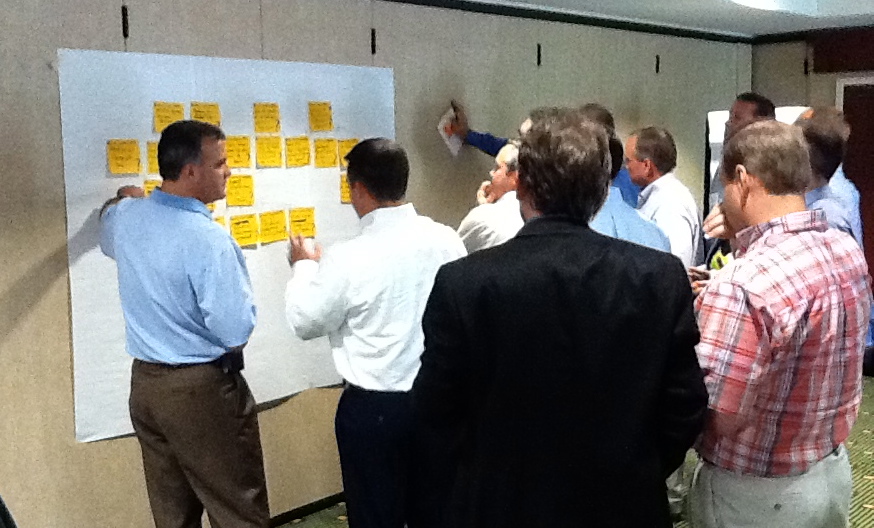 YES – the owner is your key person. The owner knows more about the problem than anybody else. If you don’t have an owner don’t do the session. It all revolves around the owner – all we’re trying to do is help. This person(s) knows everything and a good owner is one
-
 First of all there are two big things – one – it is fun – people love to find out something about themselves and find out that their way of solving problems is just as good as anybody else’s way. Nobody’s a genius when it comes to creativity and
-
 Whenever a good group suddenly lapses into “going round in circles” or adversarial discussions (however unintended or disguised ), a simple process intervention called “debriefing” always works. In debriefing, a group pauses to self-correct the discussion by getting out of content and examining its process to intercept further slippage. MinSight: