
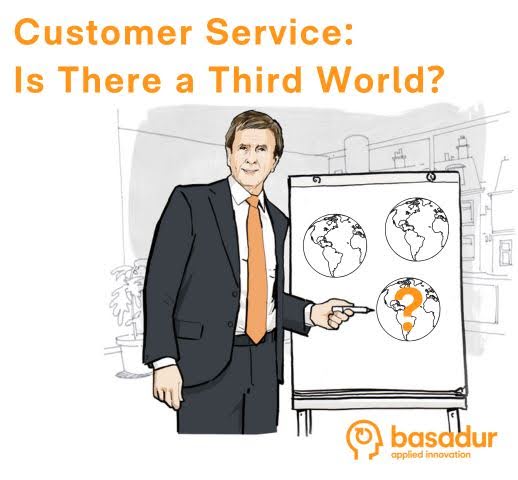
Customer Service: Is There a Third World?
In our new Industrial Cleaning Products division at P&G, as mentioned in our blog Learning by Doing, we had a very different customer than the other 12 divisions. Our customers were industrial organizations such as hotels, restaurants, large commercial laundries, manufacturing facilities, and hospitals. Purchasing our product was only the beginning of what our customers needed. Labor, equipment, and expertise in operations were more costly, being increasingly complex and difficult to manage.
However, our division was trying to repeat the company’s very successful formula that worked in the 12 retail divisions. Salespeople were to get the order and the product development people were to deliver the product to the customer. The product development people were to develop good products for the sales department, then go back and develop more good products. The sales department was to sign the customer up then go on to another call. Great in theory, but it didn’t work well because our customers needed help in ways beyond purchasing the product.
I began to realize that perhaps we were trying hard to implement a formula that wasn’t working. Perhaps we should be defining the needs of the customer and developing products that aligned. The new formula would place servicing the customer into a new, third department. The role of this Customer Service department would be primarily to “keep customers happy.” Its members would receive credit for providing superior technical services, such as problem solving, installation help, and technical information. In addition, by dipping into our company’s vast reservoirs of knowledge and expertise they could provide the best technical support our customers have ever seen.
The main idea was that rather than have customer service be something nobody gets credit for, let’s see it as an opportunity to leverage all the advantages P&G can offer to our customers, even beyond better products. This was really different from how we ran all the other divisions because our customers were not the same. I wrote my next bi-weekly report, recommending that we consider organizing a new department called customer service.
Nothing ever came of my proposition. Our general manager replied: “I found Min Basadur’s bi-weekly report very stimulating. While I haven’t got my mind around the proposition he presents, I think Min is to be complimented on the flexibility in thinking that this document demonstrates.”
Looking back, this would be a big change and risky for our general manager. He had been very successful in his previous retail career using the established P&G formula. Very likely his hands were full and safer trying to make the proven retail formula work in the industrial space. As a result, our division continued to flounder.
MinSight: When organizations find a successful formula for running their business, they often find it uncomfortable to try doing things differently especially when the business landscape changes. Deviating from the familiar and into the unknown can be strange and too risky for many managers. From this experience, I was beginning to understand how important it is for organizations to continuously master their current routines while adapting them to changing cirumstances.
Ready To Drive Change?
You’re an innovator. You just don’t know it yet. Let us show you how.