
We recently set out to conduct an initial exploratory survey of the problem solving styles of innovative leaders, folks who describe themselves as leading innovative efforts in their teams and organizations. This was a quick, first-cut study on our part to sort of ‘test the waters’ before committing to a large-scale research effort to examine the relationships between people’s problem solving style and the fundamental nature of the work they are doing, regardless of job title. We had 86 people from a diverse number of geographies, industries, and backgrounds participate in our study. The primary criteria to participate in the study was that they were actively engaged in driving creative and innovative work at a leadership level in their teams and organizations. Each person filled out the Basadur Profile which was the key driver for the study.
Our research questions:
- What would their scatter diagram look like?
- How would these people compare to our global population and other types of teams in our database?
- Would we see results that were different from what we expected to see?
Innovation is a driving force for progress. It is a driving force of economic growth, disruption, increased efficiency, competitive advantage, global progress, sustainability, adaptation, creativity, and problem-solving. To achieve success and growth, leaders of innovation play a pivotal role in their ability to drive change, foster new ideas, and navigate challenges to stay competitive and achieve long-term growth.
After publishing an article in the Harvard Business Review, on the 4 types of innovators every organization needs, we wanted to know:
What do Leaders of Innovation have in common?
Leaders of innovation share several key traits. They:
- have a visionary mindset
- are open-minded
- take calculated risks
- are adaptable, passionate, and empathetic
- are effective communicators
- are crucial to driving ideation.
Leaders of Innovation also encourage diversity, prioritize continuous learning, and demonstrate resilience. These qualities collectively contribute to a leadership style that fosters innovation and creativity within organizations. Understanding the thinking styles of innovative leaders is crucial for organizations seeking to cultivate a culture of innovation and drive long-term growth. Building on these insights, our study aims to explore further and update our understanding of the thinking styles of innovative leaders.
Do Leaders of Innovation Share Similar Thinking Styles?
Basadur has developed a scientifically valid instrument, the Basadur Profile, to assess people’s innovative thinking styles in the context of their work. A measurement of cognitive diversity in teams. As mentioned, we sought individuals who are tasked with leading innovation in their teams and organizations. We invited each of them to take the Basadur Profile. The results are visible in the scatter diagram below:
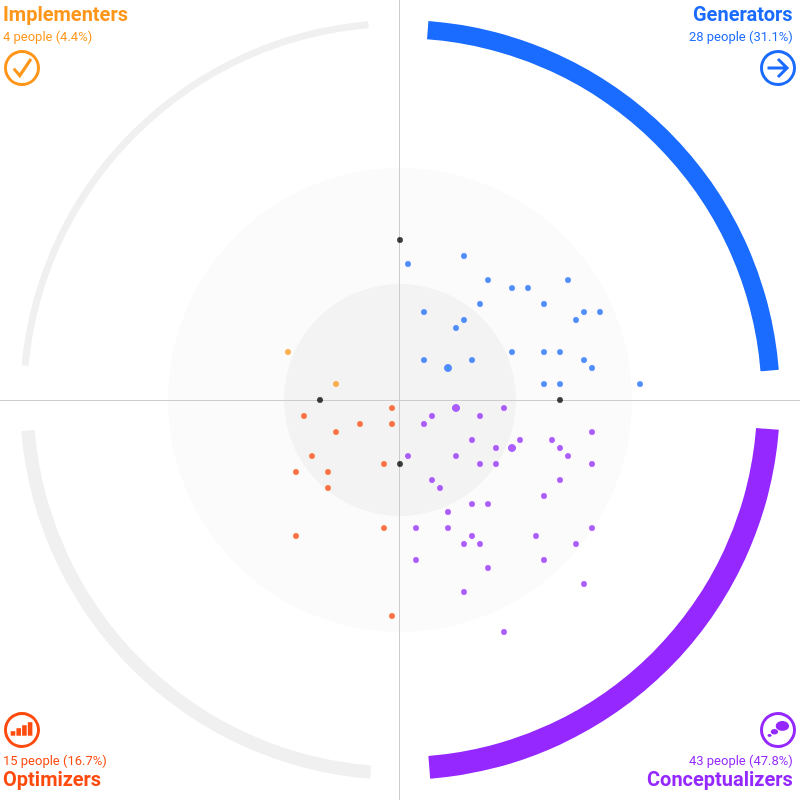
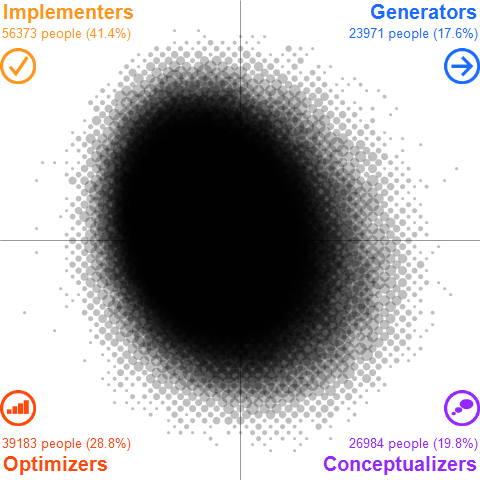
This scatter diagram is very different from one that represents the global population of people who have taken the Profile where approximately 40% of people are implementers.
Here’s what we have compiled as a scatter diagram for the global population:
We were also intrigued to dig a little deeper to compare how our study group compared with the global population on how individuals gained and used their knowledge in their roles. Here’s a graph that shows stark contrasts:
Our Leaders are Ideators & Thinkers vs. Evaluators and Experiencers
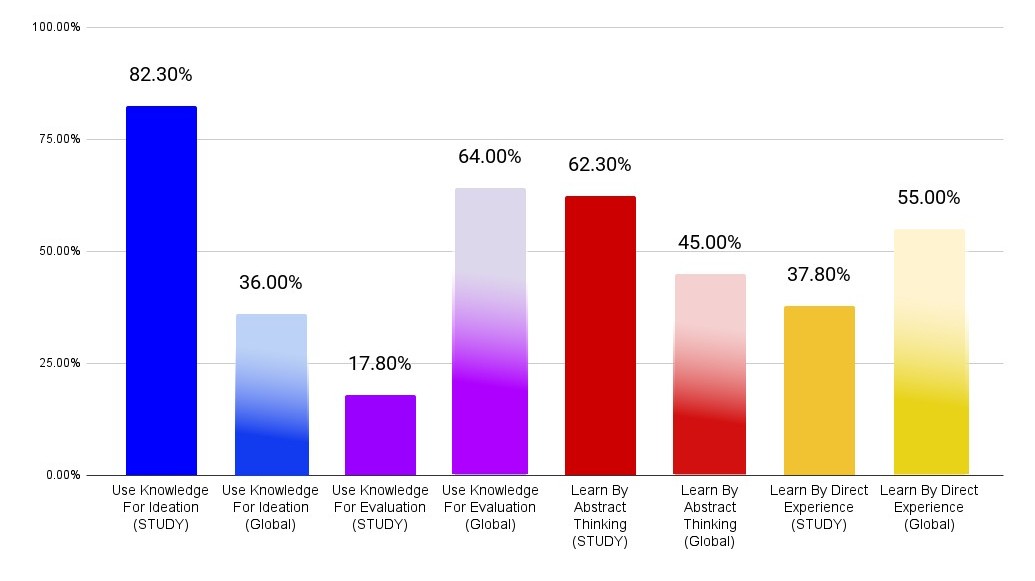 82.3% of our Innovation Leaders fell on the right side of the Basadur Profile – they are Generators and Conceptualizers. These individuals tend to use their knowledge for ideation, they’re busy being curious, finding new opportunities, and framing problems.
Of the four styles, almost half of the participants were revealed as Conceptualizers. Common traits of Conceptualizers include imaginative thinking, a big-picture orientation, comfort with ambiguity, tolerance for risk, future orientation, creative problem-solving abilities, inspiring qualities, and adaptability. These traits make conceptualizers invaluable contributors to the early stages of the innovation process.
Our results also indicate a strong representation of Generators, 35.6% of respondents. Generators excel at coming up with creative ideas and solutions to problems, are open-minded, value collaboration, are optimistic, curious, risk-takers, and open to possibilities. These traits make Generators contributions valuable when addressing complex challenges as they drive positive change within teams and organizations.
Are we surprised with what we discovered?
The short answer is that we would be surprised if our findings were any different. Leaders of innovation are tasked with driving change and newness in their organizations. Whether that be incremental improvements and enhancements to existing products and services (the shorter term) to a completely disruptive way of doing something – inventing something new and paradigm shifting (the longer term). Leaders of innovation must have a handle on both the short term innovations (n+1 improvements) and the long term INNOVATIONS (the game changers).
As such, we provide a foundational approach where innovation can be regarded as two parts of one continuous process. In it, inventing and learning follow one another in a circular pattern.
 Based on the work of W.J.J. Gordon
Inventing is the process of coming up with something new. It involves breaking old connections. When we invent, we ‘make the familiar strange.’ This allows us to view old phenomena in new ways, although this can be uncomfortable at first.
Anything new always makes people nervous, so we must make the new thing more comfortable for people. But before we do that, we must learn the “new thing” ourselves. Learning is the process of making new connections, of ‘making the strange familiar.’ This allows us to view new phenomena more comfortably.
For example, people in manufacturing dislike new things. It disrupts their desire for efficiency. They know that it takes time and effort for something new to become the new standard.
In the Generation and Conceptualization stages of our innovation process (the right-side stages) old established paradigms are broken. New products, better quality goods and services and new ways of doing things are discovered and invented, replacing previous ones.
When this happens, a well-established business process is broken, and the new one replacing it feels strange and uncomfortable. People experience a process of unlearning, as they break connections with past understanding and let go of old habits and beliefs.
In the Optimization and Implementation stages of our innovation process (the left-side stages) new ways of thinking and doing become established. New processes are devised and implemented, and these soon become the new paradigm – familiar and comfortable. This is why most of the world, as our scatter diagram of the global population shows, sees a majority of people with these two innovation styles.
Most mature organizations have an operational focus, they are operational and focussed on efficiency and profitability. Hence, many leaders of innovation face an uphill battle to change things up. This is why many businesses fail, even large, long established, well capitalized businesses like Kodak and Blockbuster can fail if and when the people tasked with leading innovation are either disregarded or overruled. It is up to every enterprise to foster a culture for trust and empathy to create an environment that encourages both the generation and conceptualization stages of the innovation process.
Thinking Styles of Leaders of Innovation Yield Implications for Leadership Development
Our findings suggest that leaders of innovation often possess key traits, such as a visionary mindset, open-mindedness, risk-taking, adaptability, passion, empathy, effective communication, encouragement of diversity, continuous learning, and resilience. Understanding and cultivating these traits can empower aspiring leaders to drive change, foster innovation, and navigate challenges to achieve long-term growth and success.
To answer our question, yes! Leaders of Innovation tend to have similar innovative thinking styles. When comparing our entire dataset of participants with the results of the study, we have never seen a skewed set like this before.
THINK THINK THINK VS. DO DO DO
If we were to come up with one conclusion, you might make an analogy to the tortoise and the hare. Whereas the average person in the world is consumed with productivity and getting things done, our brave leaders of innovation are taking time to think and ideate and look at things in an entirely different way.
We believe that these leaders of innovation have the mindset to prevent people from working on the wrong problems.
Leaders of innovation are vital for driving innovation and fostering creativity within organizations. They possess a unique set of traits and thinking styles that enable them to navigate challenges and lead successful initiatives.
Are you a leader of innovation? Join our study and see where you fit on the diagram to better support your team in achieving innovative results.